
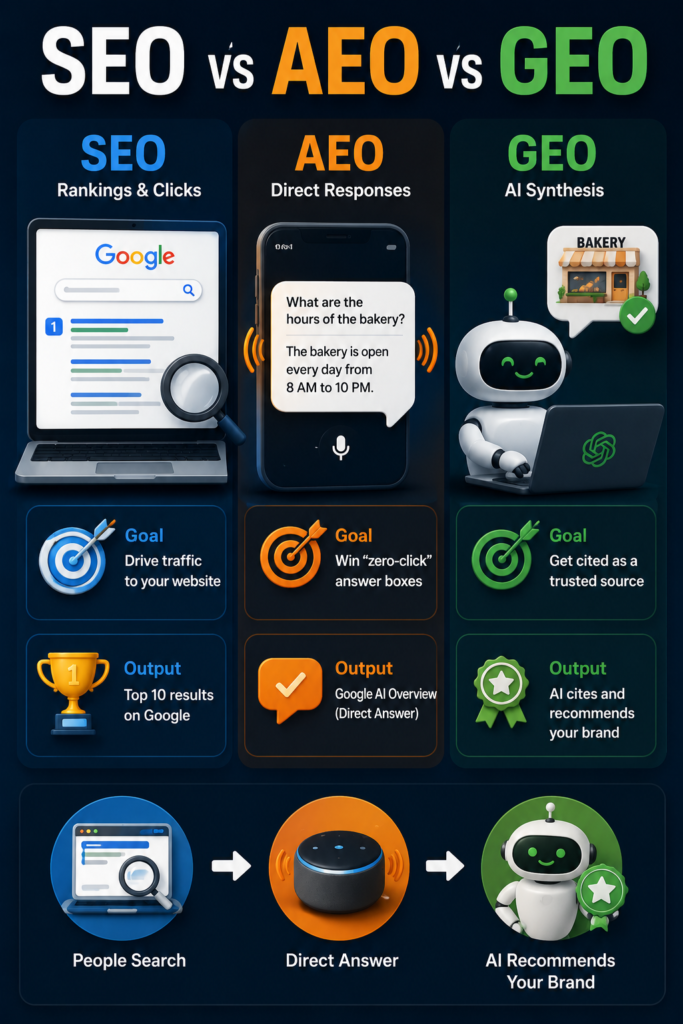
The world of digital marketing is changing faster than ever. For years, businesses focused on Search Engine Optimization (SEO) to rank on search engines like Google. Today, artificial intelligence is transforming how people search for information. Instead of browsing through multiple websites, users now ask AI assistants for direct answers.
This shift has introduced two important concepts that every website owner, blogger, and business should understand: Answer Engine Optimization (AEO) and Generative Engine Optimization (GEO).
If you want your content to appear not only in Google Search but also in AI-powered platforms like ChatGPT, Google AI Overviews, Microsoft Copilot, and Gemini, then learning AEO and GEO is essential.
In this guide, you’ll discover what AEO and GEO are, how they differ from traditional SEO, and practical strategies to optimize your content for the future of search.
What is AEO?
Answer Engine Optimization (AEO) is the process of creating content that directly answers users’ questions in a clear, concise, and structured way.
Instead of optimizing only for keywords, AEO focuses on delivering the exact answer a user is looking for.
For example, someone might ask:
- What is AEO?
- How does Answer Engine Optimization work?
- Why is AEO important?
A well-optimized page provides straightforward answers that search engines and AI assistants can easily understand and present to users.
The primary goal of AEO is to become the trusted source for direct answers.
What is GEO?
Generative Engine Optimization (GEO) is the practice of optimizing content so that AI-powered search systems can discover, understand, and reference it when generating responses.
Unlike traditional search engines that display a list of websites, generative AI tools create personalized answers by combining information from multiple reliable sources.
GEO ensures your content is:
- Easy for AI systems to understand
- Factually accurate
- Well-structured
- Rich in context
- Trustworthy and authoritative
As AI search continues to grow, GEO is becoming an important extension of traditional SEO.
Why AEO and GEO Matter
Search behavior has changed dramatically.
Many users now ask questions naturally, such as:
- What is the best construction company?
- How can I improve my website SEO?
- Which digital marketing strategy works in 2026?
Instead of clicking multiple links, users often receive a complete AI-generated answer.
If your website is optimized for AEO and GEO, your content has a better chance of influencing these AI-generated responses.
This means:
- Increased visibility
- More qualified traffic
- Greater brand recognition
- Higher trust among users
- Better long-term search performance
AEO vs GEO vs SEO
Although they are related, AEO, GEO, and SEO each have distinct goals.
| SEO | AEO | GEO |
|---|---|---|
| Focuses on ranking web pages | Focuses on answering questions | Focuses on AI-generated responses |
| Targets keywords | Targets user intent | Targets AI understanding |
| Improves Google rankings | Improves featured answers | Improves AI citations |
| Relies on backlinks and technical SEO | Relies on structured answers | Relies on authority and context |
The most successful content strategy combines all three approaches.
How AI Search Works
AI-powered search engines analyze information differently from traditional search engines.
Instead of matching only keywords, they evaluate:
- Context
- User intent
- Authority
- Expertise
- Readability
- Freshness
- Trustworthiness
The AI then creates a conversational answer using reliable sources.
This means your content should be written for both humans and AI systems.
Benefits of AEO and GEO
Implementing AEO and GEO strategies offers numerous advantages.
Better Visibility
Optimized content can appear in AI-generated answers, featured snippets, and voice search results.
Improved User Experience
Users appreciate content that answers questions quickly without unnecessary information.
Higher Authority
Publishing accurate and trustworthy content builds credibility with both readers and search engines.
Increased Organic Traffic
Helpful content naturally attracts more visitors over time.
Future-Proof Marketing
As AI becomes more integrated into search, websites optimized for GEO will have a competitive advantage.
Essential AEO Strategies
1. Answer Questions Clearly
Begin your article by answering the main question directly.
Avoid lengthy introductions before providing useful information.
2. Use Question-Based Headings
Examples include:
- What is GEO?
- Why is AEO important?
- How does AI search work?
These headings match how people search online.
3. Write Naturally
Avoid stuffing keywords.
Write as though you are explaining the topic to another person.
4. Add FAQ Sections
Frequently Asked Questions improve your chances of appearing in voice search and AI-generated summaries.
Example:
What is the difference between SEO and AEO?
SEO improves search rankings, while AEO focuses on providing direct answers to users’ questions.
5. Use Structured Content
Organize your content with:
- Headings
- Bullet points
- Numbered lists
- Tables
- Short paragraphs
Structured content is easier for AI systems to interpret.
Essential GEO Strategies
Publish Original Content
AI systems prioritize unique and valuable information over copied content.
Share real experiences, case studies, and expert insights whenever possible.
Build Topical Authority
Instead of publishing random articles, create multiple high-quality articles around a single niche.
For example, a construction company might publish content about:
- Building construction
- Sustainable construction
- Architectural engineering
- Smart homes
- Green building materials
This helps establish expertise in the field.
Demonstrate Experience
Include practical examples, project photos, and lessons learned from real work.
Experience strengthens credibility.
Keep Content Updated
AI systems prefer current information.
Review and update articles regularly to reflect the latest trends and developments.
Improve Readability
Use:
- Simple language
- Short paragraphs
- Descriptive headings
- Clear examples
Readable content benefits both users and AI.
The Role of E-E-A-T
Google emphasizes Experience, Expertise, Authoritativeness, and Trustworthiness (E-E-A-T) as key signals of quality.
To strengthen these signals:
- Publish accurate information.
- Cite reputable sources where appropriate.
- Showcase author expertise.
- Maintain an About page.
- Provide contact information.
- Include privacy and policy pages.
- Update outdated content.
These practices help both search engines and AI systems assess the reliability of your website.
Voice Search Optimization
Voice assistants continue to influence search behavior.
People often use conversational questions such as:
- How do I optimize my website for AI search?
- What is the difference between SEO and GEO?
To optimize for voice search:
- Use natural language.
- Answer questions directly.
- Include FAQ sections.
- Keep answers concise.
Common Mistakes to Avoid
Many websites struggle because they make avoidable mistakes.
These include:
- Keyword stuffing.
- Publishing AI-generated content without review.
- Writing vague introductions.
- Ignoring user intent.
- Failing to update old content.
- Using overly complex language.
- Creating thin or duplicate pages.
Instead, prioritize clarity, originality, and usefulness.
Future Trends in AEO and GEO
The future of search is becoming increasingly conversational.
Key trends include:
- More AI-generated search experiences.
- Greater use of voice assistants.
- Personalized search results.
- Increased emphasis on trustworthy content.
- Deeper integration of AI into everyday browsing.
Businesses that adapt now will be better positioned as search technology continues to evolve.
Best Practices Checklist
Use this checklist when creating new content:
- Research user questions.
- Write clear, direct answers.
- Use descriptive headings.
- Include FAQs.
- Publish original insights.
- Keep content updated.
- Improve readability.
- Build topical authority.
- Strengthen E-E-A-T signals.
- Optimize for voice search.
- Maintain fast page speed.
- Ensure mobile-friendly design.
Conclusion
AEO and GEO represent the next evolution of digital content optimization. While traditional SEO remains important, it is no longer enough on its own. Today’s users increasingly rely on AI assistants and answer engines that deliver instant, conversational responses.
By creating content that is accurate, well-structured, user-focused, and trustworthy, you can improve your visibility across both traditional search engines and AI-powered platforms. Combining SEO, AEO, and GEO into a unified strategy helps your website reach a wider audience and stay competitive in the rapidly changing digital landscape.
The future of search belongs to websites that provide real value. Start optimizing your content today, and you’ll be better prepared for tomorrow’s AI-driven search ecosystem.
FAQs
What is AEO?
AEO (Answer Engine Optimization) is the practice of optimizing content to provide clear, direct answers that search engines and AI assistants can easily present to users.
What is GEO?
GEO (Generative Engine Optimization) focuses on making content understandable, trustworthy, and useful for AI systems that generate conversational answers.
Is SEO still important in 2026?
Yes. SEO remains essential, but combining it with AEO and GEO provides the best opportunity to succeed in both traditional and AI-powered search.
How can I optimize for AI search?
Create original, accurate, well-structured content, answer user questions directly, build topical authority, and maintain strong E-E-A-T signals.
Can small businesses benefit from AEO and GEO?
Absolutely. High-quality, helpful content allows businesses of all sizes to improve visibility and establish authority in AI-driven search results.